Jamie House Design Jamie House Design

The Invisible Details That Make Your Home Feel Authentically Yours

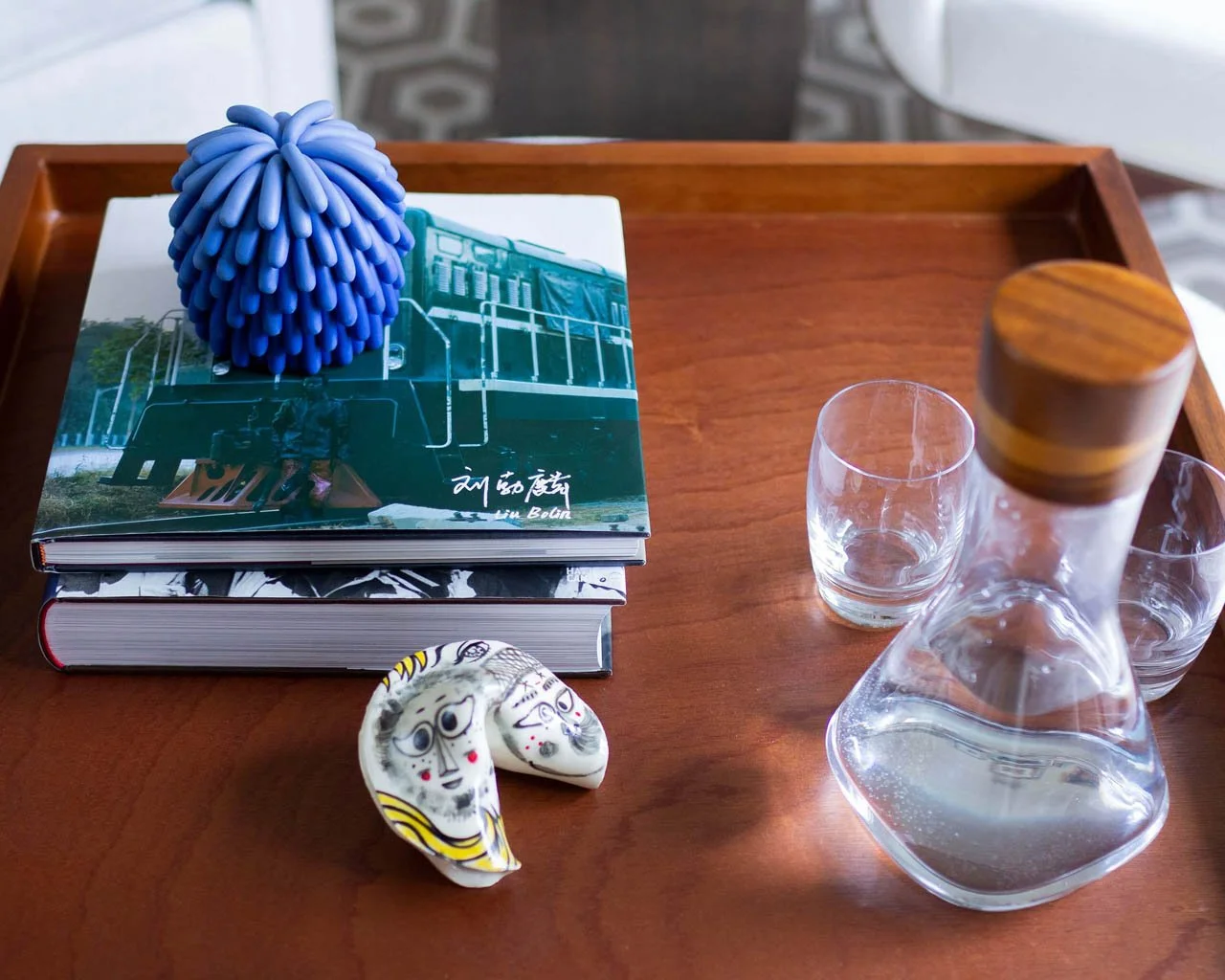
Curated coffee table styling with art books, blue sculptural object, ceramic horse figurine, and modern glassware showing personalized home decor details

There's a particular magic that happens when you walk into a home that just feels right. You can't quite put your finger on it, but something about the space makes you exhale. The colors seem to whisper to each other across rooms. The furniture feels intentional, not assembled from a catalog page. The art makes you pause, even if you're not sure why.

Your guests won't notice that your entry ceiling is painted the same warm greige as your breakfast room built-ins. They won't consciously register that you've woven three complementary patterns throughout your first floor, or that your vintage credenza sits perfectly alongside that sleek IKEA lamp. But they will notice, in that indefinable way, that your home has a soul.

This is the paradox of exceptional interior design: the details that matter most are often invisible.

The Flow They Feel But Can't Name

When you're standing in your living room, looking around and wondering how to make your home feel more you, it's easy to fixate on the obvious: new furniture, fresh paint, trendy accessories. But the homes that truly resonate; the ones that feel effortlessly sophisticated and deeply personal, are built on a foundation of invisible cohesion.

Take color, for instance. A thoughtfully curated paint palette doesn't announce itself. It doesn't demand attention. Instead, it creates a subtle through-line that makes your entire home feel intentional. When your powder room's deep charcoal echoes the veining in your kitchen marble, when your bedroom's soft sage appears again in your hallway's vintage runner, you're creating visual harmony that the eye registers as rightness, even if the conscious mind never articulates it.

This is what separates a house from a home: the connective tissue of color that makes each room feel like part of a larger, coherent story rather than a series of Pinterest boards stapled together.

Pattern: The Confident Conversation

One of the most transformative, and most intimidating, aspects of interior design is pattern mixing. We've been conditioned to play it safe, to match our throw pillows to our curtains, to choose one pattern and call it done. But this cautious approach often results in spaces that feel flat, generic, timid.

The truth? Pattern is how a room develops personality.

The key isn't matching, it's orchestrating a conversation. A bold geometric on your sofa, a delicate floral in your curtains, a classic stripe on your accent chair. Different scales, different moods, but united by a common color thread. Your guests won't analyze the individual patterns, but they'll feel the energy, the confidence, the European sensibility that comes from fearless juxtaposition.

Think of it like this: a room with a single pattern is a monologue. A room with thoughtfully mixed patterns is a dinner party; dynamic, engaging, impossible to forget.

Pattern mixing in a bedroom designed by Centennial CO interior designer Jamie House Design.

Pattern mixing mastery: this serene bedroom demonstrates how multiple patterns; striped bed skirt, botanical bedding, floral draperies, and an antique rug, create sophisticated cohesion when united by a curated green-and-white palette. The client's existing mahogany furniture pairs beautifully with new celadon nightstands, while varied textures (lace, velvet fretwork, antique chinoiserie ceramics) add depth without competing. This is the invisible orchestration that makes a room feel effortlessly pulled together rather than overly matched.

The Art of Meaningful Things

Walk through any design showroom and you'll find walls of perfectly coordinated art. Three panels of abstract gray and beige. A set of botanical prints in matching frames. Coastal photography in predictable blues.

It's all perfectly fine. It all matches. And it all says absolutely nothing.

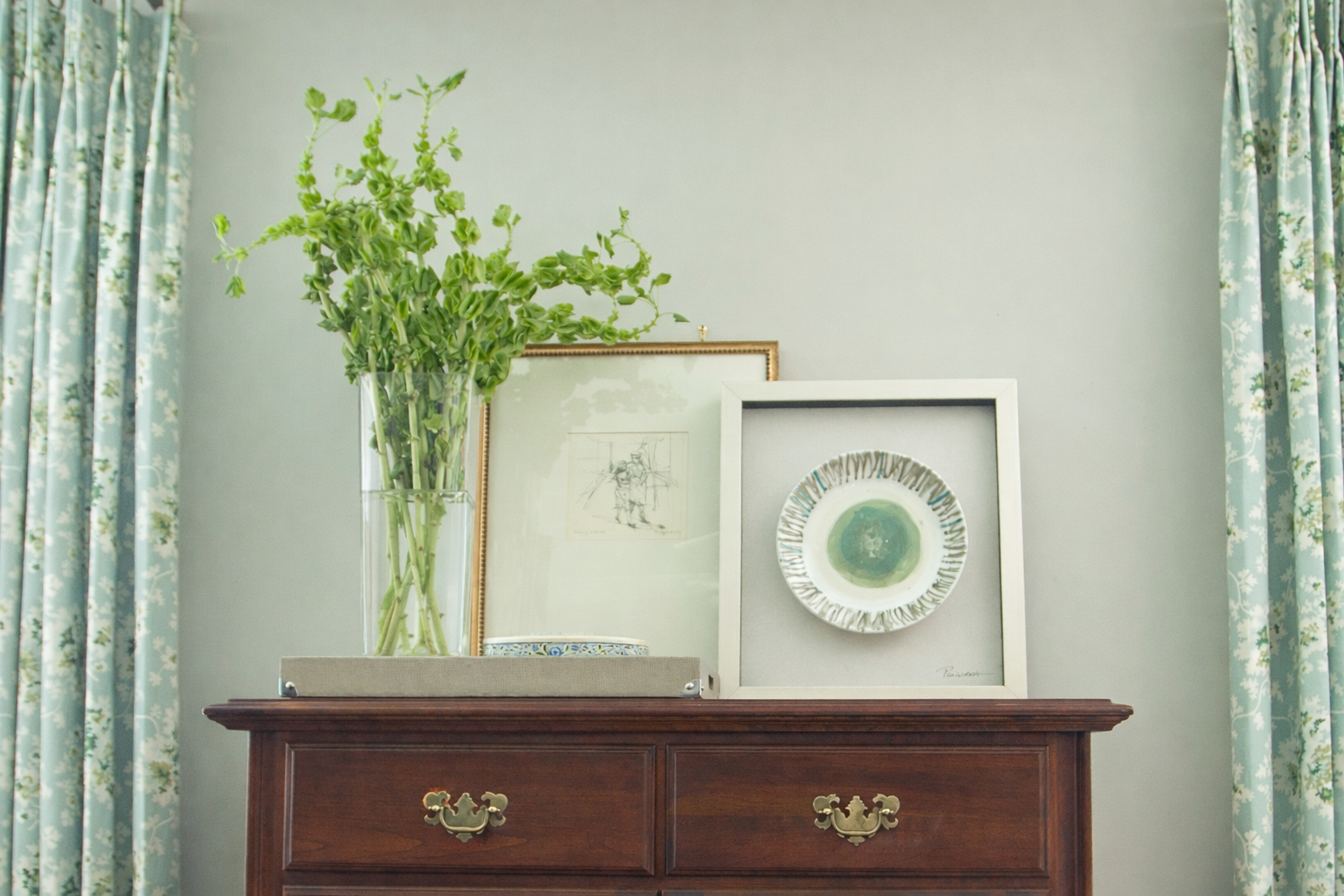
Your home deserves better than decor-by-committee. The pieces that transform a space aren't the ones that match your sofa, they're the ones that match your soul. The vintage poster you found in that Paris flea market. Your grandmother's watercolor, reframed and finally given the prominence it deserves. The contemporary print from a local artist whose perspective moved you.

Yes, these pieces require more courage than the pre-curated gallery wall from the furniture store. They might not "match" in the traditional sense. But they create something far more valuable: authenticity. And your guests, even if they never consciously register it, will sense the difference between a home decorated with meaning and one decorated with merchandise.

The same principle applies to every accessory in your home. That hand-thrown ceramic bowl holds more visual weight than a dozen mass-produced objets from the home goods aisle. The brass candlesticks you inherited tell a better story than the trendy gold accents everyone's buying this season. Trust your instincts. Choose pieces that resonate with you, and the room will resonate with others.

Function Over Fashion: The Liberation of Furniture Without Labels

Here's a secret the design industry doesn't want you to know: the brand on your furniture matters far less than its bones.

We've been taught to covet certain names, to save for designer pieces, to judge our homes by the pedigree of their furnishings. And while quality absolutely matters, provenance doesn't. A well-proportioned IKEA bookshelf, styled with intention, can hold its own beside a mid-century vintage credenza. A budget-friendly dining table with beautiful lines becomes remarkable when surrounded by a mix of antique and contemporary chairs.

What matters is shape. Scale. Function. Does this piece serve your life? Does it provide the hidden storage your family desperately needs? Does its silhouette complement the room's architecture? Does it make you happy when you look at it?

Stop shopping by brand and start shopping by instinct. Look past the label and ask: Is this piece beautifully proportioned? Is the craftsmanship solid? Does it solve a problem or fulfill a need in my home? Will I still love it in five years?

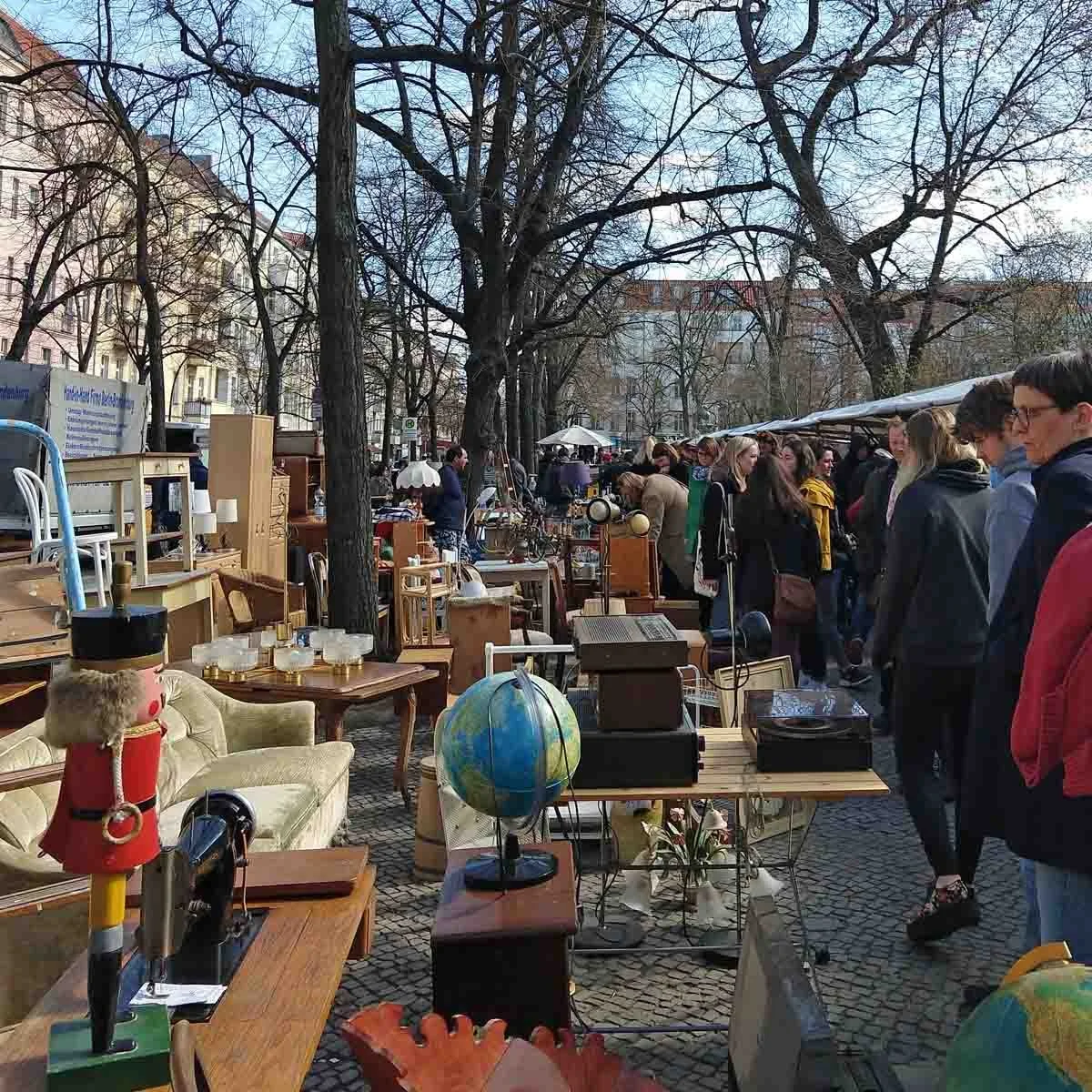
The most sophisticated spaces are the ones that mix high and low with confidence, where a flea market find sits comfortably alongside a contemporary investment piece, where function and beauty coexist without apology. This is the European approach that Americans often miss: it's not about matching everything to a single aesthetic or price point. It's about curation, about choosing each piece for its individual merit and trusting that, together, they'll create something greater than their parts.

Custom upholstered sofa detail with corded bolster pillow showing quality craftsmanship and texture in neutral linen fabric with button tufting

Color as Connection: Creating Your Home's Signature Palette

If there's one invisible detail that most dramatically impacts how a home feels, it's the paint palette. Not the individual colors themselves, but the relationship between them.

A cohesive color strategy doesn't mean painting everything the same shade of beige. It means creating a family of colors that flow from room to room, that reference and reinforce each other, that make your home feel like a single, intentional composition rather than a collection of isolated boxes.

Perhaps your palette revolves around warm, earthy neutrals with moments of deep green. Maybe it's built on shades of gray and blue with brass accents as the throughline. The specific colors matter less than the strategy: choosing a limited family of hues and distributing them thoughtfully throughout your home.

This is the detail your guests will never consciously notice, and the one that will make the biggest difference in how your home feels. When you move from your sage-and-cream living room to your adjacent dining room and find those same colors repeated in different proportions, your eye registers continuity. Flow. Intention. Home.

The Permission to Be Yourself

Perhaps the most invisible, and most important, detail of all is this: your home doesn't need to impress anyone but you.

We live in an era of Instagram perfection, where every home tour and design blog suggests there's a right way and a wrong way to live. But the homes that truly resonate are the ones that reject this pressure, that embrace their owners' quirks and passions and peculiarities.

Your home should tell your story, not echo someone else's. It should reflect your travels, your heritage, your obsessions. If you love books, let them overflow their shelves. If you collect vintage cameras, display them with pride. If your taste skews more eclectic than the current trend, lean into it.

Most people are thinking about themselves anyway. They're not scrutinizing your decor choices or judging your furniture pedigree. They're experiencing your home as an atmosphere, a feeling, a reflection of you. And when that reflection is authentic; when the details, visible and invisible, truly represent who you are, that's when the magic happens.

Custom upholstered antique vanity stool with white terry cloth cushion and decorative aqua woven trim detail in elegant bathroom interior design

The invisible details that elevate a space: this antique vanity stool, reupholstered in plush terry cloth with intricately woven aqua trim, demonstrates thoughtful design at work. The trim's precise shade echoes the client's nearby porcelain collection; a connection guests feel but rarely articulate. Soft, durable, and beautifully considered, this is the kind of purposeful detail that makes a bathroom feel cohesive rather than coincidental. It looks effortless because every choice was intentional.

Finishing Touches: Where Expertise Meets Instinct

You understand your home better than anyone. You know how you live in it, what frustrates you, what makes you happy. But sometimes, translating that intimate knowledge into design decisions feels overwhelming. You can sense that something's missing, but you can't quite articulate what.

This is where working with an interior designer becomes transformative, not because they'll impose their vision on your space, but because they'll help you see and realize your own.

At Jamie House Design, we specialize in the invisible details that make homes feel complete. We'll help you develop that cohesive color palette that creates flow throughout your space. We'll guide you in mixing patterns with confidence, in sourcing meaningful art and accessories, in blending high and low pieces into something uniquely sophisticated.

We won't push you toward trendy solutions or cookie-cutter aesthetics. Instead, we'll listen to how you want to feel in your home, we'll understand the function you need from each space, and we'll collaborate with you to create rooms that are beautifully, authentically yours.

Sometimes you just need someone to confirm your instincts. Sometimes you need help editing; knowing what to keep, what to retire, what's missing. Sometimes you need access to resources and trades that transform good ideas into finished reality. Whatever your project requires, we bring expertise without ego, helping you make decisions that you'll love not just now, but for years to come.

The Home That Feels Like Home

At the end of the day, exceptional interior design isn't about impressing your neighbors or recreating a magazine spread. It's about creating a home that makes you exhale when you walk through the door. A home where the details, visible and invisible, work together to tell your story.

Your guests might not notice that you've thoughtfully coordinated your paint palette across rooms. They might not consciously register your confident pattern mixing or your curated blend of IKEA and antiques. They might not articulate why your art feels more compelling than the generic prints they saw at the furniture store.

But they'll notice that your home has a soul. They'll feel the flow, the intention, the authenticity. And most importantly, you'll feel it too; every single day.

Because the details that truly matter aren't the ones people can name. They're the ones that make your home feel unmistakably, authentically, beautifully yours.

Ready to add those finishing touches that make your house feel like home? Jamie House Design works with homeowners throughout the Denver metro area to create spaces that are as functional as they are beautiful, as personal as they are polished. Let's start a conversation about your home →


Related Articles:

About the Author

Jamie House is an award-winning interior designer serving Centennial, Littleton, Castle Pines, and throughout Colorado. With over 20 years of experience designing luxury homes, she specializes in creating spaces where families naturally gather. Her work has been featured in Country Living, Houston Chronicle, and Design Sponge.

Schedule a Consultation | View Portfolio | Read More Articles

Jamie House Design partners with homeowners and real estate professionals throughout Littleton, Castle Pines, Centennial, and greater Denver to create homes where beauty and intention meet. If you're beginning your search or ready to transform a property you've found, we'd welcome the conversation. Contact us to explore what's possible.

Read More
Jamie House Design Jamie House Design

Building New vs. Renovating in Centennial & South Denver: A Designer's Guide

Modern living room renovation in Centennial with brown leather swivel chairs, geometric ottoman, and vintage Monopoly board wall art

You've outgrown your current home. The kitchen is too small, the layout feels closed off, and you're daydreaming about spaces that actually work for how your family lives now. So here's the big question: Do you build new, or do you renovate what you have?

It's one of the most common dilemmas I hear from clients in Centennial, Highlands Ranch, Castle Pines, and Littleton. And honestly? There's no one-size-fits-all answer. The right choice depends on your budget, your timeline, your neighborhood, and what you're actually trying to achieve.

Let me walk you through both options so you can make a confident decision.

The Appeal of New Construction

There's something magical about starting with a blank slate. New construction means you get to design a home that's built specifically for your life; no compromises, no "working around" existing walls or outdated systems.

Why People Choose New Construction

Complete customization
Every room, every closet, every outlet placement is designed around how you live. Need a mudroom that handles sports gear and backpacks? A kitchen island sized for your entertaining style? A primary suite on the main floor for aging in place? You decide it all from the beginning.

Modern systems and efficiency
New homes come with current building codes, which means better insulation, energy-efficient windows, modern HVAC systems, and smart home wiring. Your utility bills will likely be lower, and maintenance headaches significantly reduced for the first decade.

No surprises (if done right)
When you work with a qualified builder and designer from the start, you know exactly what you're getting, and what it will cost. There are no hidden structural issues, no asbestos remediation, no "we found something behind the walls" moments.

Perfect for growing families
If you're planning to stay in your home for 15+ years and want a space that adapts as your kids grow (or as you transition into retirement), new construction offers that long-term flexibility if it’s planned correctly from the beginning.

The Realities of New Construction

Higher upfront investment
In South Denver, new custom builds typically start around $400–$600 per square foot, depending on finishes and location. A 3,000-square-foot home could easily run $1.2M–$1.8M+ before land costs. If you're in Castle Pines or certain Highlands Ranch neighborhoods, expect the higher end of that range.

Longer timeline
From land purchase to move-in, you're looking at 16–20 months minimum. Design, permitting, and construction all take time; and weather, material availability, or permit delays can extend that further.

Decision fatigue is real
You'll make hundreds of choices: tile, paint, cabinet hardware, light fixtures, countertops, flooring, doorknobs. It's exciting but exhausting. Having an interior designer guide you through this process is invaluable; they help you make decisions that work together cohesively, not just individually.

You'll need somewhere to live during the process
Unless you already own land or are selling your current home with flexible timing, you may need temporary housing while your new home is built.

The Case for Renovation

Renovating your existing home can be just as transformative as building new, especially if you love your neighborhood, your lot, or the architectural character of your current house. I've seen 1970s Centennial ranches and historic Littleton homes become stunning, functional spaces through thoughtful renovation.

Why People Choose Renovation

You stay in the neighborhood you love
Maybe you're two blocks from great schools. Maybe your kids have lifelong friends on the block. Maybe you've spent years cultivating your backyard. Renovating lets you keep all of that while getting the home you need.

Often more cost-effective (but not always)
Renovations typically cost $200–$400 per square foot depending on scope. A $150K–$300K kitchen and main floor renovation can completely transform how your home functions without the price tag of new construction.

Faster than building from scratch
Most renovations take 6–8 months from design to completion. Even a major whole-home remodel construction usually wraps up in under a year. You're back in your home (or moved in, if you stayed elsewhere) much faster than new construction.

Preservation of character
If you have a historic Littleton bungalow or a classic Centennial ranch with great bones, renovation lets you keep the charm while updating function. I love projects where we preserve original hardwoods, expose beautiful brick, or work within interesting architectural details that new construction simply can't replicate.

Smaller environmental footprint
Reusing your existing structure is inherently more sustainable than building from scratch. If environmental impact matters to you, renovation is the greener choice.

The Realities of Renovation

Hidden surprises can blow budgets
Once walls come down, you might discover outdated wiring, plumbing issues, foundation cracks, or mold. Even with a thorough inspection beforehand, renovations often uncover problems that add 10–20% to your budget. Always build in a contingency fund.

You're working within existing constraints
You can't always get exactly what you want. Structural walls limit layout changes. Ceiling heights are fixed. Window placement is constrained. Sometimes the compromises are minor; other times they're deal-breakers.

Living through construction is challenging
If you stay in your home during a renovation, expect dust, noise, and disruption. But here's what many homeowners don't realize: contractors often add 10–15% to the project cost when families remain in the home during a full renovation. Why? Daily cleanup becomes more extensive, parking can be limited for subcontractors and material deliveries, and work schedules may need to accommodate your family's routine (waiting until you leave for work, pausing during nap times, or avoiding early morning noise). These accommodations slow progress and increase labor costs. Even if you move out temporarily, coordinating timing and logistics adds stress. Kitchens and bathrooms are particularly tough to live without; and trying to cook in a makeshift setup or share one bathroom among four people tests everyone's patience.

Permits and approvals can be tricky
Especially in historic districts (parts of Littleton, for example), you may face restrictions on what you can change. Even in non-historic areas, additions and structural changes require permits, inspections, and sometimes neighborhood HOA approvals.


Breaking Down the Costs: What to Expect

Let's get specific about budgets, because this is where many families get stuck. Here's what I typically see in South Denver:


New Construction Budget Breakdown

Land: $200K–$600K+ (depending on location and lot size)
Design & Architecture: $20K–$50K
Construction: $400–$600/sq ft
Interior Design & Furnishings: $50K–$150K+

Example: A 3,500 sq ft custom home in Castle Pines:

  • Land: $400K+

  • Design: $40K+

  • Construction: $1.75M (at $500/sq ft)

  • Design & furnishings: $100K+

  • Total: ~$2.3M+

Renovation Budget Breakdown

Design & Planning: $10K–$30K+
Construction: $200–$400/sq ft (depending on scope)
Contingency: Add 15–20% for unknowns

Example: Whole-home renovation of a 2,800 sq ft Centennial ranch:

  • Design: $30K+

  • Construction: $560K (at $200/sq ft for major updates)

  • Contingency: $85K+

  • Total: ~$665K+

Example: High-end kitchen and primary suite remodel:

  • Design: $30K+

  • Kitchen: $120K+

  • Primary suite: $80K+

  • Contingency: $30K+

  • Total: ~$260K

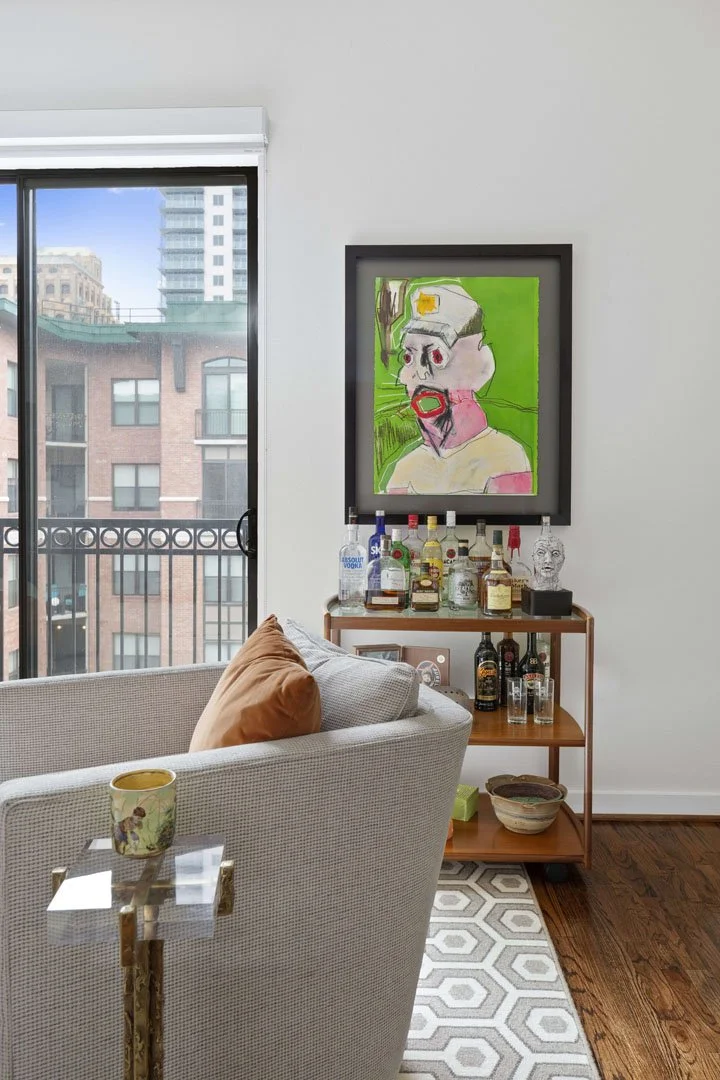
Eclectic living room design in South Denver featuring mid-century bar cart, abstract artwork, and contemporary seating with orange accent pillows

How to Decide: Ask Yourself These Questions

Still not sure which path is right for you? Here's how I help clients think it through:

Choose New Construction If:

  • You need significantly more square footage than you currently have

  • Your lot or neighborhood no longer fits your lifestyle

  • You want a completely custom home designed around your exact needs

  • Your current home has major structural or systems issues that would cost nearly as much to fix as building new

  • You're planning to stay in this home for 15+ years

  • You have the budget and timeline flexibility for a longer process

Choose Renovation If:

  • You love your neighborhood, schools, and community

  • Your home has good bones and a layout that can be adapted

  • You need to update finishes, systems, or specific rooms rather than changing the entire footprint

  • You want to be back in your home within 6–12 months

  • Your budget is $600K or less for the project

  • You value the character and charm of your existing home

Still Unsure? Consider a Hybrid Approach

Some families do a major renovation now (kitchen, primary suite, main living spaces) and plan for an addition later. Or they renovate their current home while they search for land and plan new construction, giving them time and flexibility to get everything right.

Contemporary dining room interior design in Denver with round metal table, gallery wall artwork, and modern black dining chairs

The Designer's Role in Both Scenarios

Whether you build new or renovate, working with an interior designer early in the process makes a massive difference. Here's why:

For New Construction:

Before permits are pulled, a designer can review floor plans to:

  • Optimize layouts for how you actually live

  • Ensure furniture (existing and future) fits properly

  • Plan built-in cabinetry and storage where it matters most

  • Design electrical and lighting layouts that support your routines

  • Coordinate with your builder on finish selections and timelines

Starting with a designer means your new home is functional and beautiful from day one, not just builder-grade that you "fix" later.

For Renovations:

A designer helps you:

  • Maximize your existing footprint without costly additions

  • Navigate structural limitations creatively (where walls can't move, how to work with ceiling heights, etc.)

  • Avoid expensive mistakes like ordering the wrong size appliances or choosing materials that won't work with your subfloor

  • Coordinate with contractors to ensure the design vision is executed correctly

  • Make the most of your budget by investing in the right places and saving where it doesn't matter

Many clients tell me they wish they'd brought me in sooner. The earlier a designer is involved, the fewer costly changes you'll make mid-project.

Living room renovation in Highlands Ranch featuring extensive gallery wall with vintage photographs, modern art, and curated home accessories

Common Mistakes to Avoid

After 20 years and projects across three continents, I've seen these mistakes repeatedly. Here's what to watch out for:

New Construction Mistakes:

  • Not involving a designer until after the floor plan is final and construction has begun. By then, it's often too late to optimize layouts or plan built-ins properly and the Builder is very hesitant to make changes as they add to cost and can cause delays.

  • Underestimating how long decisions take. If you're indecisive or very busy, build in extra time; or hire a designer to narrow choices for you.

  • Choosing a builder based only on price. The lowest bid often means cut corners or change orders that end up costing more.

  • Forgetting about landscaping and outdoor spaces in the budget. You need 10–15% of your total budget for this.

Renovation Mistakes:

  • Not having a realistic contingency fund. Expect 15–20% of your budget to go toward surprises. If you don't have it, don't start the project.

  • Doing too much DIY to "save money." Unless you're truly skilled, DIY often costs more when professionals have to fix mistakes.

  • Living in the home during major work without a plan. Have a strategy for meals, bathing, and sanity breaks. Sometimes it's worth renting a short-term place.

  • Changing your mind mid-project. Every change order adds cost and delays. Make decisions during design, not during construction.

The Bottom Line

New construction gives you complete control and a home designed specifically for your life, but it requires a larger budget and longer timeline. Renovation lets you transform your existing home more affordably and quickly, but you'll work within existing constraints and deal with some unknowns.

Neither choice is "better", it's about what works for your family, your budget, and your goals.

And here's the most important thing: whichever path you choose, bring in an interior designer early. We help you avoid expensive mistakes, make cohesive decisions, and create a home that's both beautiful and functional. After designing homes from Berlin to Shanghai to South Denver suburbs, I can tell you the best projects—new or renovated—start with a clear vision and a team that understands how you actually want to live.

Mid-century media console styling in Littleton with gallery wall arrangement, decorative objects, and layered framed artwork

View more from this Centennial modern home renovation project →

Ready to Explore Your Options?

Whether you're leaning toward new construction or renovation, I'd love to help you think through what makes sense for your family and budget.

Three ways to work with Jamie House Design:

Design Consultation — $500+
2-3 hour in-home session with design direction, layout advice, and realistic budget guidance. Perfect for families who need expert direction before committing to a project.

Partial Design Services — $5,000–$25,000+
Professional design for specific phases (kitchen, primary suite, space planning) while you manage contractors and procurement. Great for capable homeowners who want design expertise without full-service management.

Full-Service Design — $25,000–$100,000+
Complete project management from concept through installation. I handle architectural planning, contractor coordination, all selections, procurement, and final styling. You get a cohesive, move-in-ready home.

Serving: Centennial, Castle Pines, Highlands Ranch, Littleton, Cherry Hills Village, Greenwood Village, and Lone Tree.

Schedule a consultation or call to discuss your project.


About Jamie House Design

With 20+ years of international design experience and a minor in Architecture from Texas Tech, Jamie House brings both creative vision and technical expertise to every project. Based in Centennial, she works exclusively within South Denver suburbs, bringing a global design perspective to the neighborhoods she calls home.

Related Articles:

Read More
Jamie House Design Jamie House Design

Before + After: A Transitional Kitchen Remodel

Littleton CO interior designer Jamie House Design remodeled kitchen with two tone cabinets.

The clients who interest me most aren't the ones starting from scratch. They're the ones who have a home with real potential and a clear sense of how they want to live in it, they just need someone to figure out how to get there without blowing the whole budget to do it.

This project was that. A young couple, serious entertainers, mid-century sensibility, a house that had good bones under a dated and compartmentalized layout. They didn't need a teardown. They needed someone to figure out what to keep, what to change, and how to make it feel like them.

The kitchen: one wall changes everything

The original kitchen was closed off from the dining room; functional in isolation, but wrong for how they lived. They cook together. They have people over constantly. The separation between kitchen and dining room meant the person cooking was always missing the conversation.

Opening the wall between the two spaces and creating a pass-through and serving area was the move that changed everything else. Once that was decided, the rest of the kitchen followed logically.

We reimagined the cabinetry layout while keeping as much of the existing material as we could repurpose. The tile floors stayed, they had genuine character and kept the budget where it needed to be. The range stayed too. Most of the cabinetry stayed too, for budget reasons. Not every decision requires replacement, and keeping what's working is part of what makes a thoughtful renovation different from an impulsive one.

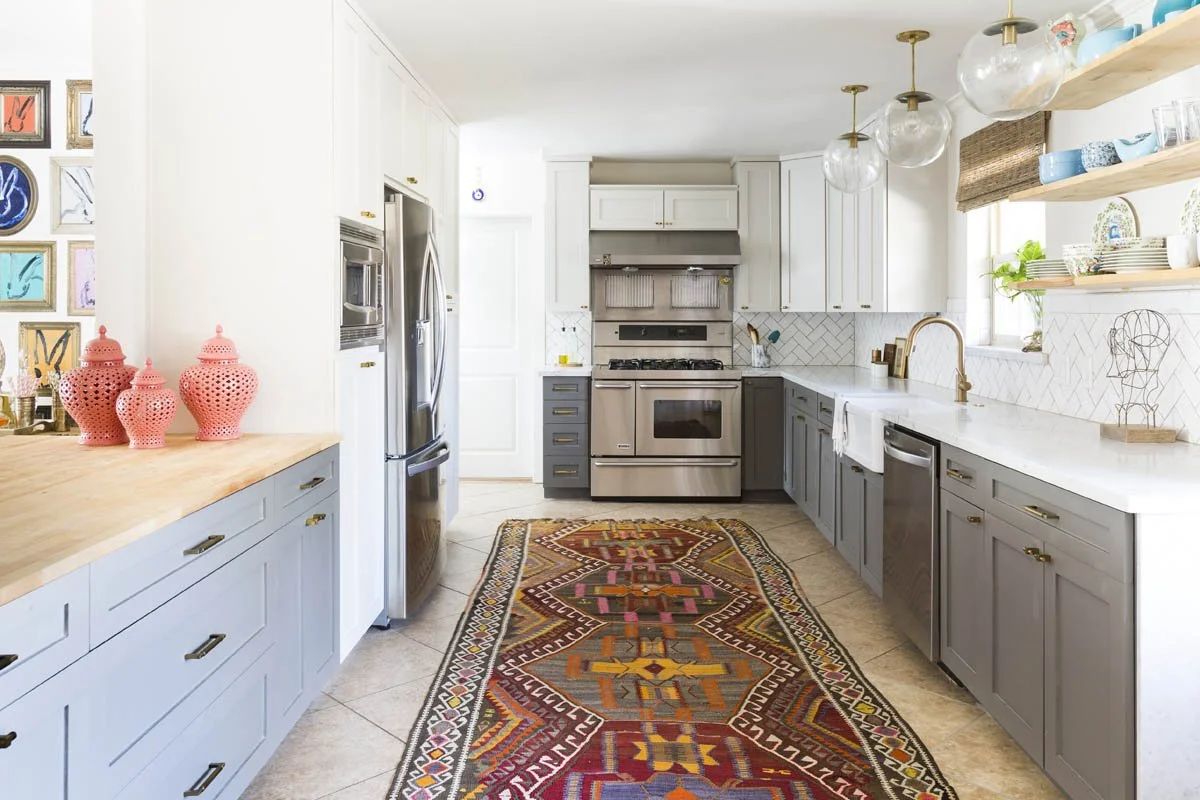
What changed: painted cabinetry in a soft slate blue and crisp white, brass hardware, open shelving that lets their things actually be seen, globe pendant lights that hit the mid-century note they were after, and a vintage Turkish runner underfoot that adds warmth without trying too hard.

The result is a kitchen that functions the way their life does; open, connected, ready for people.

Littleton CO interior designer Jamie House Design opened up the kitchen to the dining room in this kitchen remodel.

AFTER

BEFORE

Personality in the Details

The woman of the house has a genuine love of bunnies, not as a theme, but as a real thing that matters to her. So rather than relegating it to a tchotchke on a shelf, we leaned into it: Hunt Slonem's Lee Jofa wallpaper in the dining space, which creates an unexpected, joyful contrast to the kitchen's more structured palette.

This is the kind of decision that makes a home feel personal rather than assembled. When something specific to the people who live there gets treated as a real design element instead of an afterthought, the whole room changes register.

Bold dining room designed by Littleton Interior Designer Jamie House Design.

AFTER

BEFORE

Beyond the Kitchen

The scope here was larger than just the kitchen. They also wanted a proper primary suite; which the original floor plan didn't really have, with his-and-hers walk-in closets and a connection to the backyard that didn't exist before. We reconfigured the back of the house to make that work: new doors opening to a pool area, wood flooring replacing dated carpet, a bathroom redesigned from a former bedroom.

Each of these decisions was made with the same logic as the kitchen; what can we keep, what needs to change, and how do we make it cohesive rather than piecemeal. The result is a house that reads as a whole rather than a collection of separate renovation decisions made at different times.

Wallpaper accent wall in bedroom designed by Interior Designer Jamie House Design

AFTER- DOORS TO THE POOL, CLOSETS RECONFIGURED

Bedroom before remodeling added doors to the pool.

BEFORE - NO DOOR TO THE BACKYARD

Black walls in primary bathroom after remodel by LIttleton CO interior designer Jamie House Design.

AFTER

Primary bedroom before remodeling to primary bathroom.

BEFORE- bedroom turned into bathroom

Before these rooms were functional but disconnected, from each other and from the people living in them. Now they're not. That's what a renovation should do, and it doesn't require starting over to get there.

Littleton CO interior designer Jamie House Design designed this hall bathroom on a tight budget.

AFTER

hall bathroom in need of remodeling

BEFORE

If you're working with a home that has good bones and a layout that isn't quite working, I'd love to hear about it.

Read More
Jamie House Design Jamie House Design

Inside a JHD Home: A Cozy Modern Refresh for an Empty Nester Family

When a couple approached Jamie House Design to transform their longtime family home into a refined, clutter-free sanctuary for their next chapter, I knew the vision required more than cosmetic upgrades—it called for thoughtful reinvention. This cozy modern refresh was designed with intention, warmth, and lasting beauty in mind.

With a blend of modern traditional interiors, streamlined updates, and soulful personalization, this project reflects my signature approach to luxury interior design that balances style with real life.

Living room interior design by LIttleton CO interior designer Jamie House Design

The Design Vision: Modern Meets Timeless

The homeowners—now empty nesters—wanted to elevate their home’s aesthetic while preserving its familiarity and emotional comfort. Jamie House Design’s goal? To create a space that felt fresh and current, yet timeless—a place where every room flowed effortlessly into the next.

Through the lens of high-end interior design, I focused on:

  • Clean, cohesive architectural detailing

  • A gut renovation of the kitchen and bathrooms

  • Subtle transitions that connect each space with warmth and clarity

The result is a home that feels both grounded and elevated—inviting, practical, and beautifully personal.

Littleton CO living room fireplace remodel by Jamie House Design

AFTER

Centennial CO living room before remodel

BEFORE

AFTER

BEFORE

Architectural Harmony: Reworking the Moldings

One of the most impactful changes was refining the existing architectural elements. Rather than removing the original trim and molding, I chose to streamline and unify these details throughout the home. This created a sense of visual continuity and sophistication without losing character.

What was once a series of disjointed rooms now feels like one intentional, connected environment—a hallmark of personalized interiors that support both movement and mood.

Traditional remodeled kitchen by Littleton interior designer Jamie House Design

Kitchen Remodel: From Dated to Delightfully Functional

The heart of the home—the kitchen—underwent a complete gut renovation. My design replaced bulky cabinetry and outdated finishes with:

  • Clean-lined millwork in warm, neutral tones

  • Subtle textures and stone for depth

  • Clever, space-saving storage solutions

This space now serves as both a gathering hub and a clutter-free culinary oasis, proving that interior design in Centennial CO can honor form and function.

Brushed nickel hood in remodeled Littleton kitchen.

AFTER

Littleton 90s kitchen before remodel by interior designer Jamie House Design

BEFORE

Breakfast room interior design by Littleton interior designer Jamie House Design

Primary bathroom remodel in Littleton CO builder spec home

Bathrooms Reimagined: Calm, Clean, and Elevated

The primary suite received a full transformation, including a completely redesigned primary bathroom that now feels like a private retreat. I focused on:

  • Understated luxury through materials and lighting

  • Smart storage to simplify daily rituals

  • A spa-like atmosphere with timeless finishes

I also reimagined the powder bath and secondary bathrooms to echo the home's overall aesthetic—clean, elevated, and intuitive.

Each space flows seamlessly into the next while offering its own unique energy—an approach rooted in soulful interior design.

Primary bathroom designed by Littleton interior designer Jamie House Design

AFTER

Primary bathroom medicine cabinets interior design Jamie House Design

AFTER

BEFORE

Littleton primary bathroom before remodel

BEFORE


A Space for Everything, So Everything Has Space

One of the most powerful transformations was invisible to the eye but essential to the experience: creating a space for everything.

This design centered around reducing clutter and making it easy to stay organized. Every drawer, nook, and built-in was designed with intention—allowing the home to function effortlessly while still feeling serene and beautiful.

This is where luxury interior design meets real life. It’s not about perfection—it’s about support.

Primary bedroom remodel by Littleton interior designer Jamie House Design
Dining room remodel by Littleton interior designer Jamie House Design
Living room interior design by Littleton interior designer Jamie House Design

Final Thoughts: A Home That Grows With You

At Jamie House Design, I believe your home should evolve with you—supporting your needs, reflecting your values, and feeding your soul.

This cozy modern refresh is a testament to what’s possible when design is rooted in listening, clarity, and timeless intention.

Whether you’re transitioning into a new life chapter or simply craving a home that feels more aligned, My approach to interior design in Centennial CO ensures every detail speaks to you.


Ready to design a home that supports your next chapter?

Let’s talk about creating something timeless, modern, and fully yours.
Book a Discovery Call

Read More

Search Posts


Featured Posts