What to Do With a Room That Has No Good Natural Light
Every house has one. The room that faces north, or sits in the center of the floor plan with no exterior wall, or has windows that look directly into a fence six feet away. The room where the light never quite arrives, where lamps are on at noon, where every paint color you try looks flat and a little sad.
The instinct is usually to fight it, to paint it white and hope for the best, or to avoid the room entirely and let it become the place where things get stored that don't have anywhere else to go.
Neither of those is the answer. A room without good natural light isn't a design problem to solve. It's a design condition to work with. And working with it, rather than against it, produces rooms that are often more interesting than their sun-drenched counterparts.
First: Stop Trying to Make It Look Bright
This is the counterintuitive move that changes everything.
The reflex when a room is dark is to paint it white, install recessed lighting on a bright dimmer, and fill it with light-colored furniture. The logic makes sense; more reflection, more light. The result is almost always a room that looks washed out during the day and fluorescent at night. White paint in a room without natural light doesn't read as bright. It reads as grey, or blue, or vaguely institutional, depending on what little light the room does receive.
A dark room painted a warm, rich color; a deep green, a warm terracotta, a charcoal with brown undertones, a navy that reads almost black, does something completely different. It stops apologizing for the lack of light and instead creates a mood that the lack of light makes possible. These are the rooms that feel like they have atmosphere. The rooms that feel intentional rather than overlooked.
The rooms in historic homes and old European apartments that everyone falls in love with in design magazines are almost never bright. They're warm, layered, and rich. Most of them have very little natural light. That's not a coincidence.
Paint: Go Warm, Go Deep, or Go Home
In a room without natural light, paint color does more work than in any other room in the house. The choice matters more, and the margin for error is smaller.
Warm undertones are essential. Cool whites, grey-based neutrals, and anything with blue or green undertones will read cold and flat in a dark room. The light that does enter, whether from windows, lamps, or overhead fixtures, has a color temperature, and that temperature interacts with your paint. Warm paint colors absorb and reflect warm light. Cool paint colors absorb and reflect nothing.
Deep colors create depth. A room painted a saturated, deep color has visual depth that a pale room doesn't. The eye reads the darkness as dimension rather than limitation. Farrow & Ball's Down Pipe, Studio Green, Mole's Breath, Benjamin Moore's Black Forest Green, Salamander, Newburyport Blue, these are colors that make a room feel considered rather than dim.
Off-whites, if you must. If the room's function requires a lighter wall; a home office where you need to feel alert, a child's room, choose an off-white with strong warm undertones. Creamy whites, linen tones, warm taupes. Not bright white. Never cool white.
Finish matters too. A matte or flat finish absorbs light rather than reflecting it back harshly, which is usually the right choice for a dark room. Eggshell if you need washability.
Lighting: Layer It Like Your Life Depends on It
Recessed lighting alone is the fastest way to make a dark room feel like a dentist's office. The overhead wash of light from cans in the ceiling is flat, directionless, and produces shadows that make people and rooms look worse than they are.
A room without natural light needs layered artificial lighting; multiple sources at multiple heights, each doing a specific job.
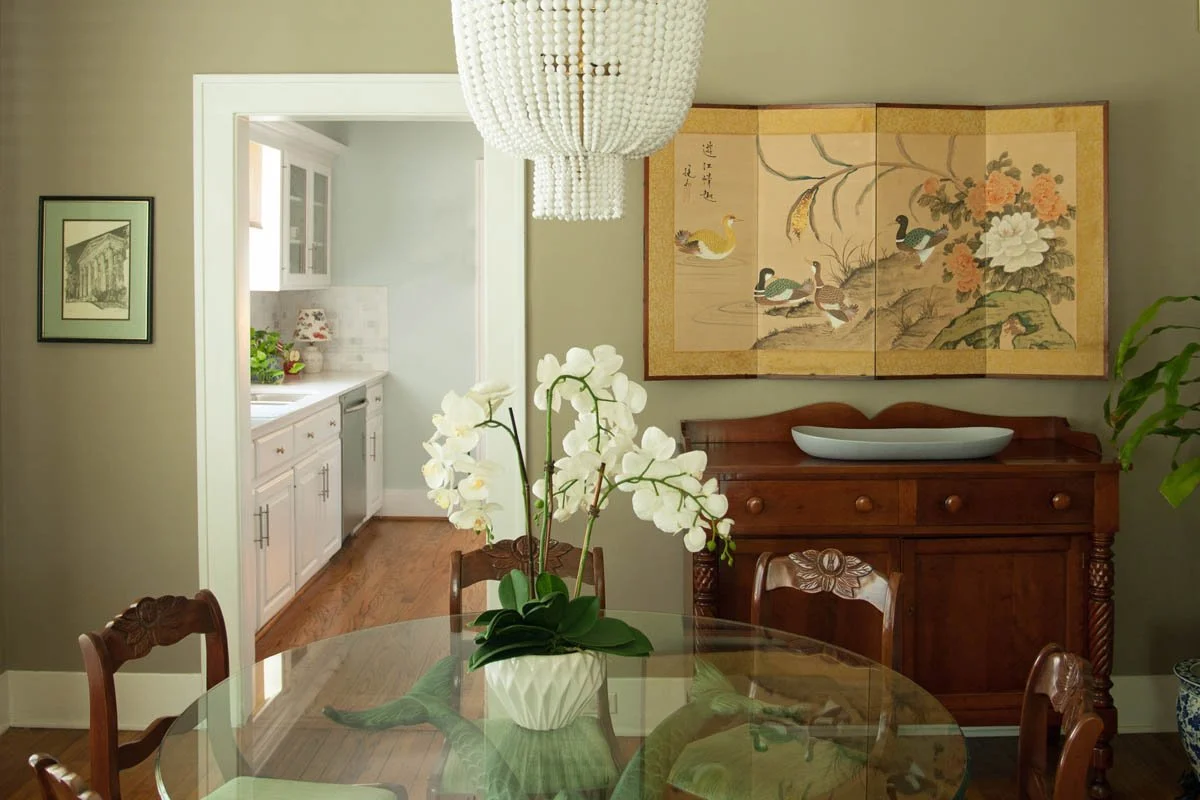
Ambient light is the base layer; general illumination that lets you move through the room safely. In a dark room this can come from a ceiling fixture, but choose one that directs light downward and upward rather than a bare recessed can. A statement pendant or chandelier that throws light in multiple directions is better than a grid of recessed lights.
Task lighting is specific to the activity; a desk lamp, a reading lamp next to a chair, under-cabinet lighting in a dark kitchen. This is the light you actually use when you're using the room, and it should be positioned for the task rather than for the room.
Accent lighting is the layer most people skip and the one that makes the most difference. Picture lights on art, small lamps on shelves, a lamp on a console, candlelight; these create points of warmth that draw the eye and make a room feel inhabited rather than lit. In a room without natural light, accent lighting is what prevents the room from feeling like a waiting room after dark.
Bulb temperature matters more than most people realize. In a dark room, use bulbs in the 2700K–3000K range, warm white, not daylight. Daylight bulbs (5000K+) in a room without natural light produce a cold, clinical quality that no amount of good furniture will fix.
Dimmers on everything. Every single source in a dark room should be on a dimmer. The ability to adjust light levels throughout the day and evening is what makes a dark room livable.
Mirrors: Strategic, Not Everywhere
Mirrors are the most overused solution for dark rooms and the most misunderstood. A mirror doesn't create light it reflects what's already there. In a room with no natural light, a mirror reflects the lamp across the room or the wall behind you. Which can be useful, but only if placed correctly.
Place mirrors to reflect a light source, not a wall. A mirror hung opposite a window, even a small window, even one with a north-facing view, catches and bounces whatever light enters. A mirror hung opposite a lamp does the same with artificial light. A mirror hung opposite another wall just makes the room look like it has two identical walls.
One well-placed large mirror is more effective than several small ones scattered without intention. And a mirror with a frame that reads as furniture, substantial, warm, material, contributes to the room rather than just reflecting it.
Furniture and Materials: Lean Into Warmth
Dark rooms reward warm materials in a way that bright rooms don't need. In a sun-filled space, warm wood tones and textured fabrics are beautiful but not essential, the light does a lot of the atmospheric work on its own. In a dark room, the materials carry that weight.
Warm wood tones, walnut, oak with an amber finish, cherry; absorb lamplight and glow in a way that painted or lacquered surfaces don't. A dark room with a substantial walnut coffee table or a set of oak side chairs feels entirely different from the same room with painted pieces in the same configuration.
Texture matters more in low light than in bright light. A velvet sofa, a chunky knit throw, a jute rug, a linen curtain; these catch light differently than smooth surfaces and create visual interest that flat materials don't. In a dark room, texture is how the eye finds something to engage with.
Avoid high-gloss surfaces. Glass tabletops, lacquered finishes, and polished stone reflect light in ways that can look cold and bright-spot-y in artificial light. Matte and honed finishes absorb and diffuse rather than reflect.
The Room That Has No Good Light Is Often the Best Room in the House
Given the choice between a north-facing library painted in deep forest green with a velvet sofa, a reading lamp, and art on every wall; and a bright, south-facing sitting room with white walls and matching furniture, most people will spend their time in the library.
Dark rooms done well are intimate, calm, and specific. They feel like somewhere. They're the rooms guests gravitate toward and the rooms homeowners use more than they expected when the house was being designed.
The mistake is treating the lack of light as a problem to overcome rather than a condition to design for. A room without natural light is an invitation to create atmosphere that sunlight would actually work against.
If you have a room that's never worked, dark, awkward, avoided, and you want to figure out what it actually wants to be, a consultation is the right place to start.
If this was useful, these might be too: