A Designer's Guide to Lighting: How to Layer Light in Your Home

Lighting is one of the decisions most homeowners make last and most designers think about first. Get it wrong and a beautifully designed room still feels off — flat, harsh, or somehow incomplete. Get it right and the room works at every hour of the day without anyone being able to explain exactly why.
Here's how I think about it.
Lighting works in layers
A good lighting plan has three distinct layers, each doing a different job.
Overhead lighting is the foundation; recessed cans, a chandelier, a flush-mount. It provides general illumination and sets the baseline brightness for a room. This is the layer most homes have covered, usually by the builder or electrician, and it's often where the plan stops. It shouldn't.
Accent lighting is the detail layer; LED strips under toe kicks, beneath upper cabinets, inside glass-front cabinetry, along a cove ceiling. These additions do something overhead fixtures can't: they highlight architecture, add depth at eye level, and make a room feel warm in the evening rather than just lit. In a kitchen, under-cabinet lighting is functional as much as aesthetic — it puts light where you're actually working.
Lamps and sconces are the human-scale layer. Table lamps, floor lamps, wall sconces; these bring light down to where people are, soften the contrast between lit and unlit areas, and make rooms feel inhabited rather than illuminated. In living rooms and bedrooms especially, this layer is what determines whether the room feels comfortable to be in after dark.
Most homes are missing the second and third layers entirely. That's why they feel fine in daylight and somehow wrong at night.
Dimmers are non-negotiable
A fixture without a dimmer is a binary switch, fully on or fully off. That's almost never what you actually want.
Dimmers let a room serve multiple purposes across a single day. A kitchen that needs bright task lighting at 7am can shift to something warmer and lower at dinner. A dining room that's well-lit for a family meal can be dramatically different for a dinner party. A bedroom can have reading light that doesn't make the room feel clinical.
Every decorative fixture, pendants, chandeliers, sconces, should be on a dimmer. Recessed cans benefit from them too, though the bigger value comes from the decorative layer. If you're renovating and can only add dimmers in two rooms, start with the kitchen and the primary bedroom.
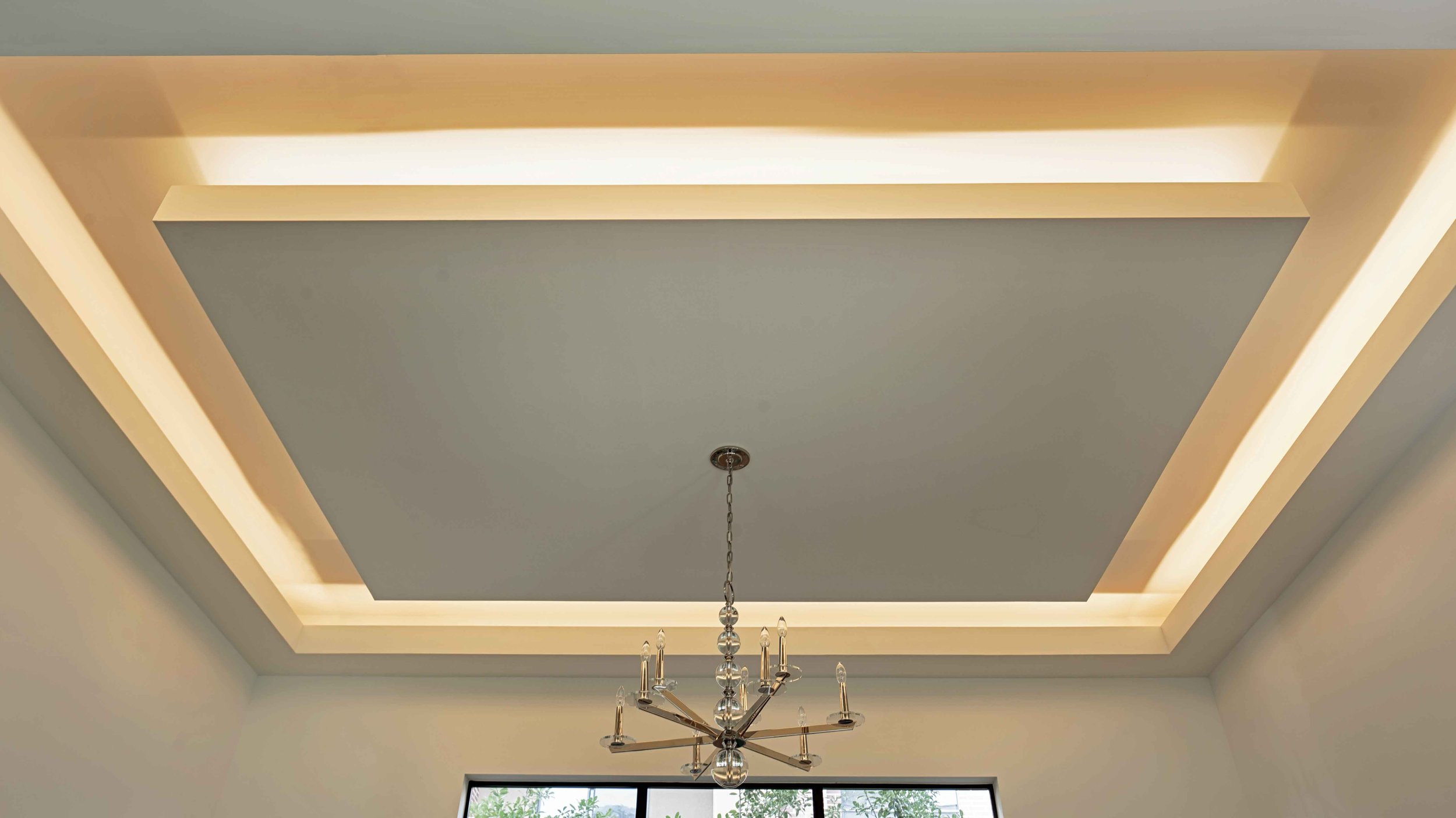
Custom cove lighting with layered double LEDs creates the illusion of a floating ceiling, while a sculptural chandelier adds balance. Together, they bring a luminous, ethereal mood to this Centennial dining room.
Color temperature matters more than most people realize
Not all light is the same color, and the difference is more significant than the numbers suggest. Color temperature is measured in Kelvin, lower numbers are warmer (more amber), higher numbers are cooler (more blue-white).
2700K–3000K is warm white — the range that works well for bedrooms, living rooms, and dining rooms where you want the light to feel comfortable rather than clinical. Most residential spaces feel right in this range.
3000K–3500K is neutral white — appropriate for kitchens and workspaces where you need clarity without harshness. Some people prefer this throughout the house; others find it too cool for living spaces.
4000K and above reads as distinctly cool and blue-toned. It works in garages, utility spaces, and home offices where task visibility matters most. In living spaces it tends to feel institutional.
The mistake I see most often: mixing color temperatures in the same room or open-plan space. Recessed cans at 3500K paired with lamps at 2700K creates a visual mismatch that makes a room feel unsettled in a way that's hard to diagnose. Commit to one temperature range per space, or at least per zone.
LED: what's worth knowing
LED is the practical choice now; longer lifespan, significantly lower energy use, and the technology has improved enough that quality LEDs render color accurately and don't flicker. The caveats are worth knowing.
Not all LEDs dim well. Cheap bulbs on a dimmer often buzz, flicker, or drop suddenly rather than fading smoothly. It's worth spending more on quality bulbs for any fixture that will be dimmed.
Color rendering index (CRI) tells you how accurately a bulb renders colors compared to natural light. For living spaces, look for CRI 90 or above. Lower CRI bulbs make colors look muddy; this is why things sometimes look different at home than they did in the store.
If you're planning a renovation in Centennial, Highlands Ranch, or Littleton and want to think through a lighting plan before the electrician is done, that's the right time for a consultation. Lighting decisions made after the rough-in are more limited and more expensive than the ones made during it.
If this was useful, these might be too: