How to Find Materials That Make Your Home Yours
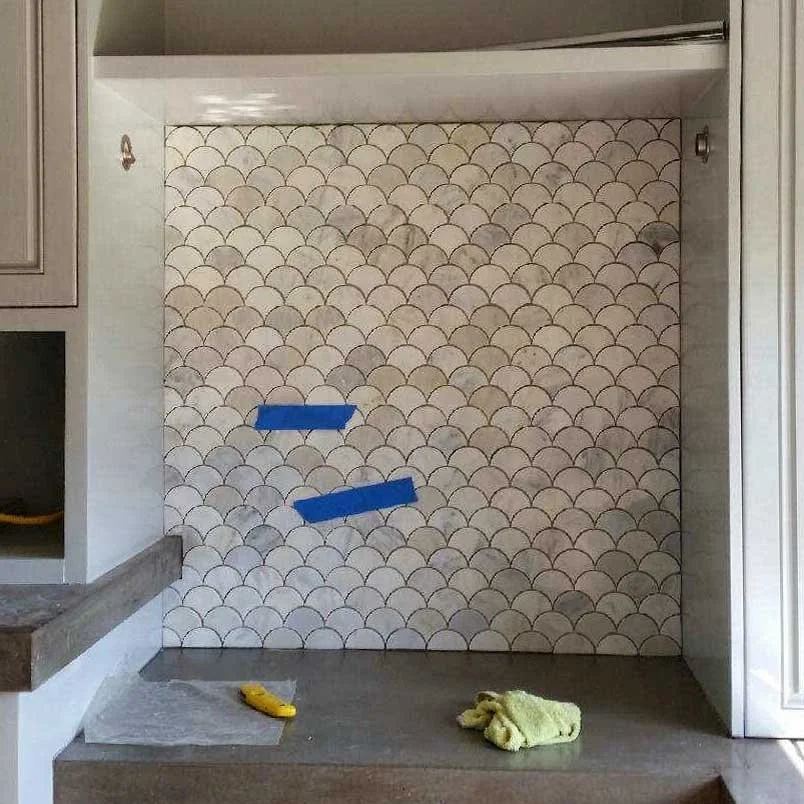
I got a call from a potential client, she’d just newly renovated her kitchen. Everything was beautiful; the execution was flawless, the materials were quality, the contractor did excellent work. She'd invested over $100,000.
"It looks exactly like my neighbor's kitchen," she said. "And the model home down the street. And three other houses I've been in this month. Why doesn't it feel like mine?"
Because it wasn't. It was beautiful, and so were the inspiration kitchens, but they weren’t her. The kitchens could be in anyone’s home. Nothing unique, just a showroom kitchen really. And that’s beautiful, especially when you’re comparing it to your 1990s or older kitchen that’s barely hanging on.
But when you invest a significant amount of money, and time, and discomfort, in a remodel it sure it should be expected that it feels like a dream.
Exactly what you never knew you could have.
She'd chosen everything from one high-end retailer's catalog. Same marble, same fixtures, same hardware available at half the houses in Highlands Ranch. Beautiful, yes. Generic, absolutely.
This is what happens when everyone sources from the same five places. You get safe, predictable, forgettable results.
After 20 years designing homes internationally and now exclusively in South Denver Suburbs, here's what I know: the difference between a home that feels collected and one that feels catalog-ordered isn't about spending more, it's about looking beyond the obvious.
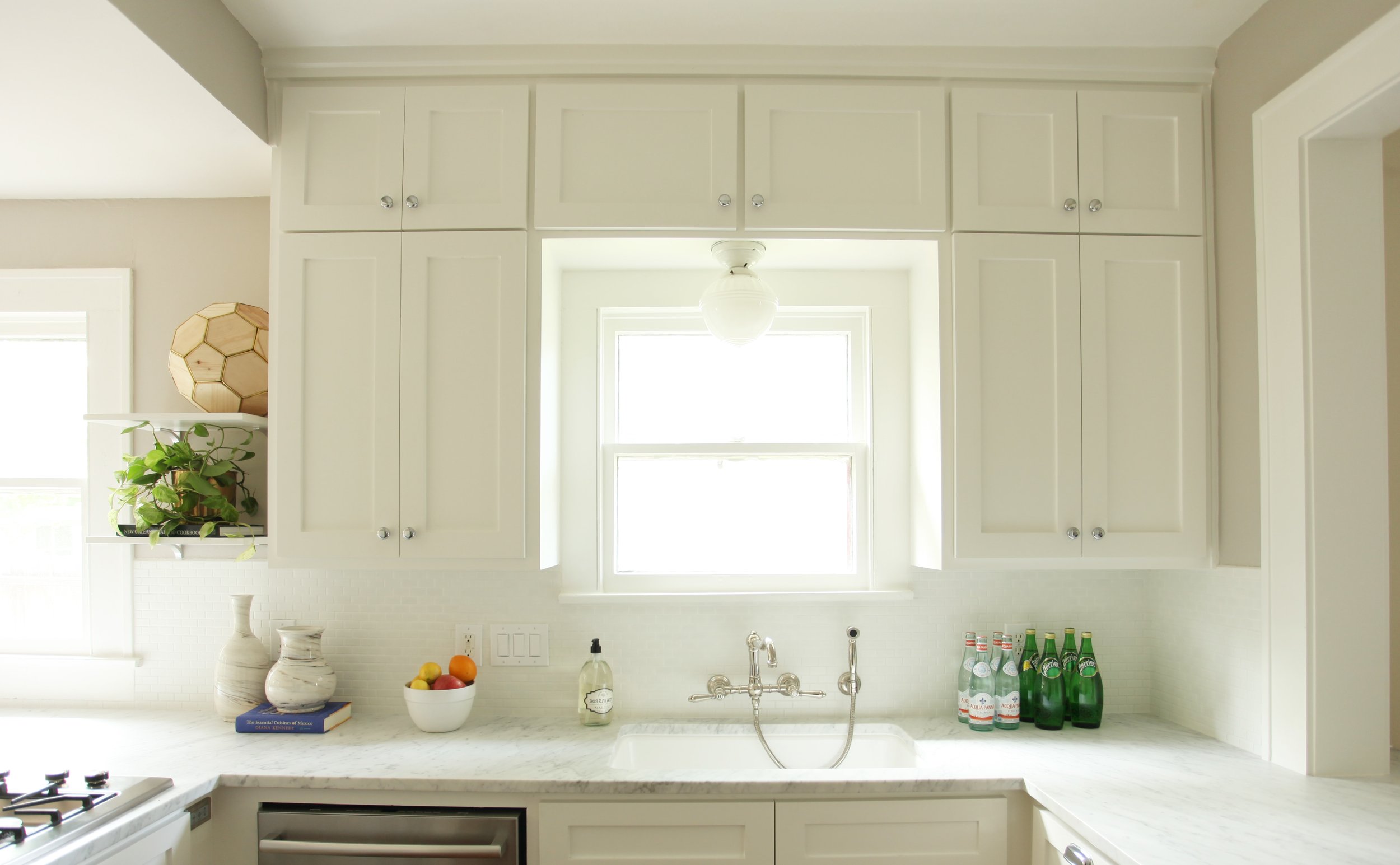
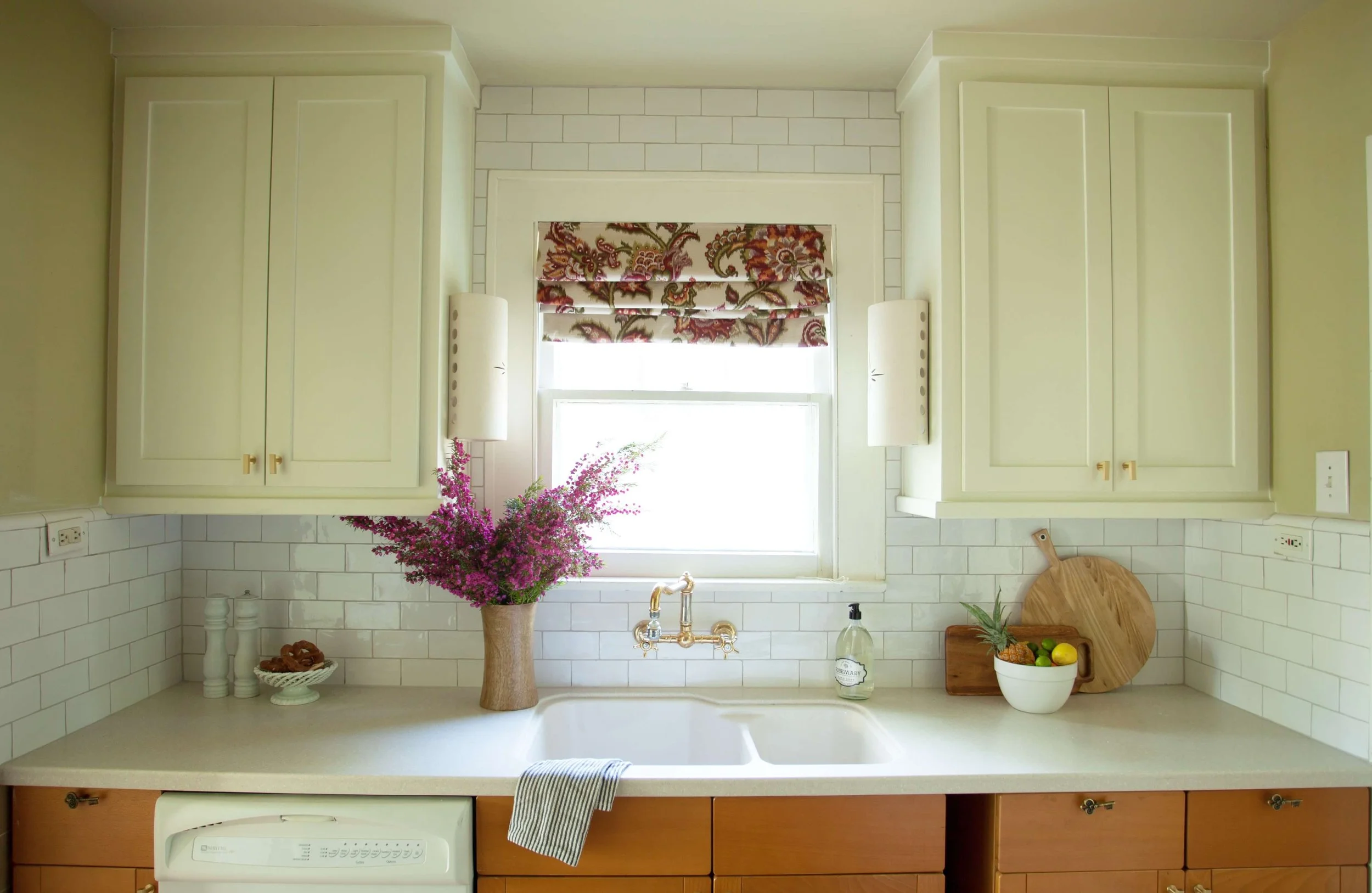
This kitchen remodel in a historic Craftsman bungalow is designed to be both fitting in the style of the house and also modern. The client requested everything white. We found a beautiful marble slab for the counters, that’s mostly white but also has some depth in the veining. The micro mosaic white backsplash touches on the unexpected a bit where we could have used a white subway tile. The polished nickel wall mounted kitchen sink is shiny and new but is right at home in a historic house. And the touch to set it all off, the antique light fixture over the sink, in all white and milk glass.
Why Sourcing Matters
Walk into most newly renovated homes in Centennial, Castle Pines, or Highlands Ranch and you'll see the same white subway tile, the same quartz countertops, the same light fixtures, the same everything. Not because people lack taste, because they're all shopping at the same stores.
Or worse: they're asking their contractor what materials to use.
Here's what happens. Homeowners think hiring a designer will cost too much. So they ask their contractor for material recommendations. The contractor, who's skilled at building but not trained in design, and who's not getting paid to spend hours selecting materials, tells them what's easiest for him. What he's installed a hundred times already. What he can get quickly. What won't cause problems.
You end up with the same white subway tile, same quartz counters, same brushed nickel hardware as the last fifteen kitchens he built. Because that's what he knows works. Not what makes your kitchen special, what makes his job efficient. And it looks fine. But did you just spend $100,000 for your kitchen to look fine?
Or here's the other pattern I see constantly: a flipped house hits the market. Everything's new, everything's neutral, everything's beautifully staged. It looks amazing in photos. People tour it and think "this is exactly what I want", so they copy it.
But that house was designed for everyone. Designed to sell fast. Designed to offend no one. Designed with whatever's currently trendy because that's what moves properties.
You're not designing a kitchen to sell next year. You're designing a kitchen to live in for the next ten or fifteen years. Trendy dates fast. Generic feels empty. Copying a flip means your home looks like a flip.
The question isn't "should I get white subway tile?" It's "if I get white subway tile, how can I make it unique?"
And I’ll challenge you further, does subway tile fit in the era your house was built? If so, great we’ll do it! But we’ll do it handmade and not bright white so it has some depth and doesn’t look like a bathroom tile in your kitchen.
Your home should tell your story. When you incorporate a vintage brass towel bar from an estate sale, handmade Delft tile, and a statement light fixture with actual history, your space has layers. Each piece has a story. Together they create something that feels yours, not staged.
You avoid the "I've seen this before" feeling. If your light fixtures come from the same big box stores everyone uses, your home will look like everyone else's. Source differently, look different.
There's always a way to add personality. Even if your major finishes are done and you're not ripping out the subway tile; there are always places to inject uniqueness. The towel bar. The cabinet pulls. The lighting. The art. The thinking that there's not just one way, there's always a way.
The High-Low Strategy (How I Actually Work)
I almost never specify all-expensive or all-budget materials. That's not how you create interesting spaces. You mix deliberately, splurge where it matters, save where it doesn't, and layer in the unexpected.
When Major Finishes Are Already Done
Your tile is installed. Your counters are in. You're not starting over. But you still want personality.
Lighting:I usually go very modern and simple for recessed cans and basic task lighting. then go all out for statement fixtures. An antique chandelier over the dining table. Vintage sconces flanking the bathroom mirror. A crazy-beautiful pendant over the kitchen island that nobody else has.
There are several excellent antique lighting stores in Denver. Etsy has thousands of vintage fixtures properly rewired for safety (double check before ordering that you’re ordering a fixture safe for US installation). You can find something stunning for $300-$800 that makes the whole room.
Hardware: Your cabinet boxes aren't changing, but the pulls can. Unlacquered brass that develops patina over time. Vintage crystal knobs from an estate sale. Leather pulls from an Etsy maker. These small changes transform generic cabinets into something special.
Plumbing fixtures: You can't afford Waterworks. Me too, most of the time. But here's what works: splurge on the faucet everyone sees, go more utilitarian on the shower plumbing nobody notices. Keep the finishes consistent (all brushed nickel or all brass), but allocate budget to what's visible.
Also: Waterworks has an outlet. Check it. I've found $1,200 faucets for $800.
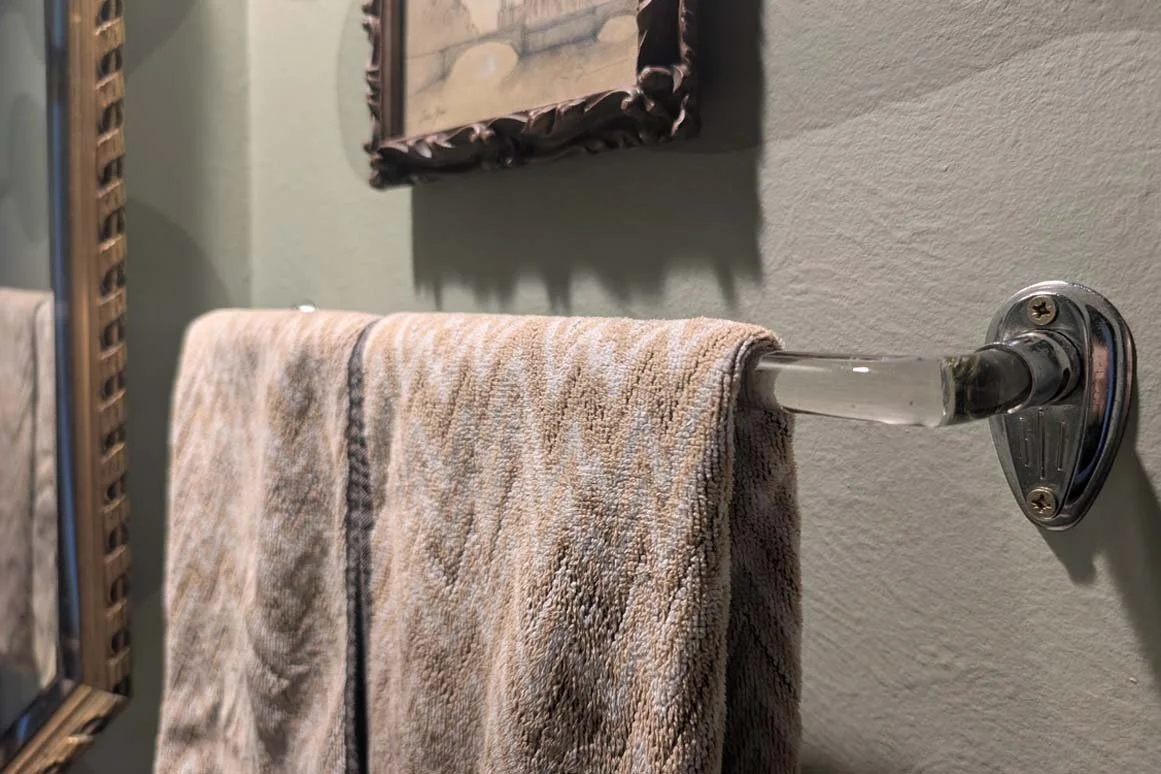
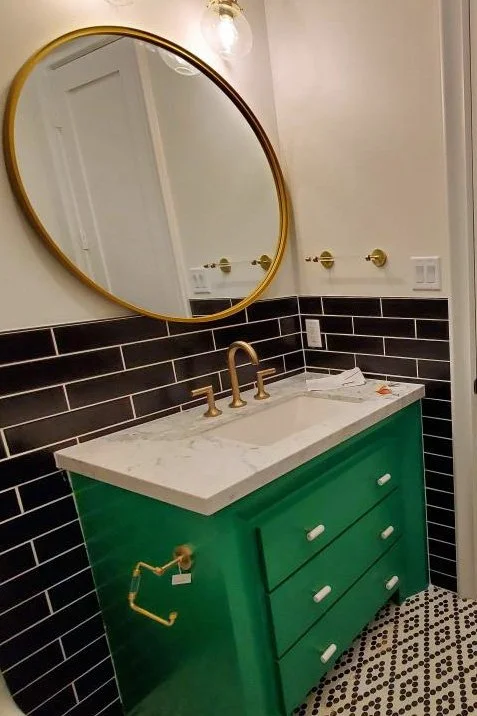
Accessories: This is where you can completely change the feeling without construction. Antique towel bars instead of chrome from Home Depot. Vintage wall hooks. A stunning glass towel rod (pictured above) I found on Etsy that's perfect for hand towels and cost $65.
The High-End Tile Problem (And How to Solve It)
You love the Ann Sacks showroom. Everything is beautiful and costs $40-$80 per square foot. Your budget is not that.
Here's what I do: figure out what you actually love about the Ann Sacks tile. Is it the color? The texture? The pattern? The handmade quality?
Can you use it sparingly in special places? If not, recreate it strategically:
Field tile from commercial source (Floor & Decor, The Tile Shop): $3-$8 per square foot. Use this for 80% of the installation.
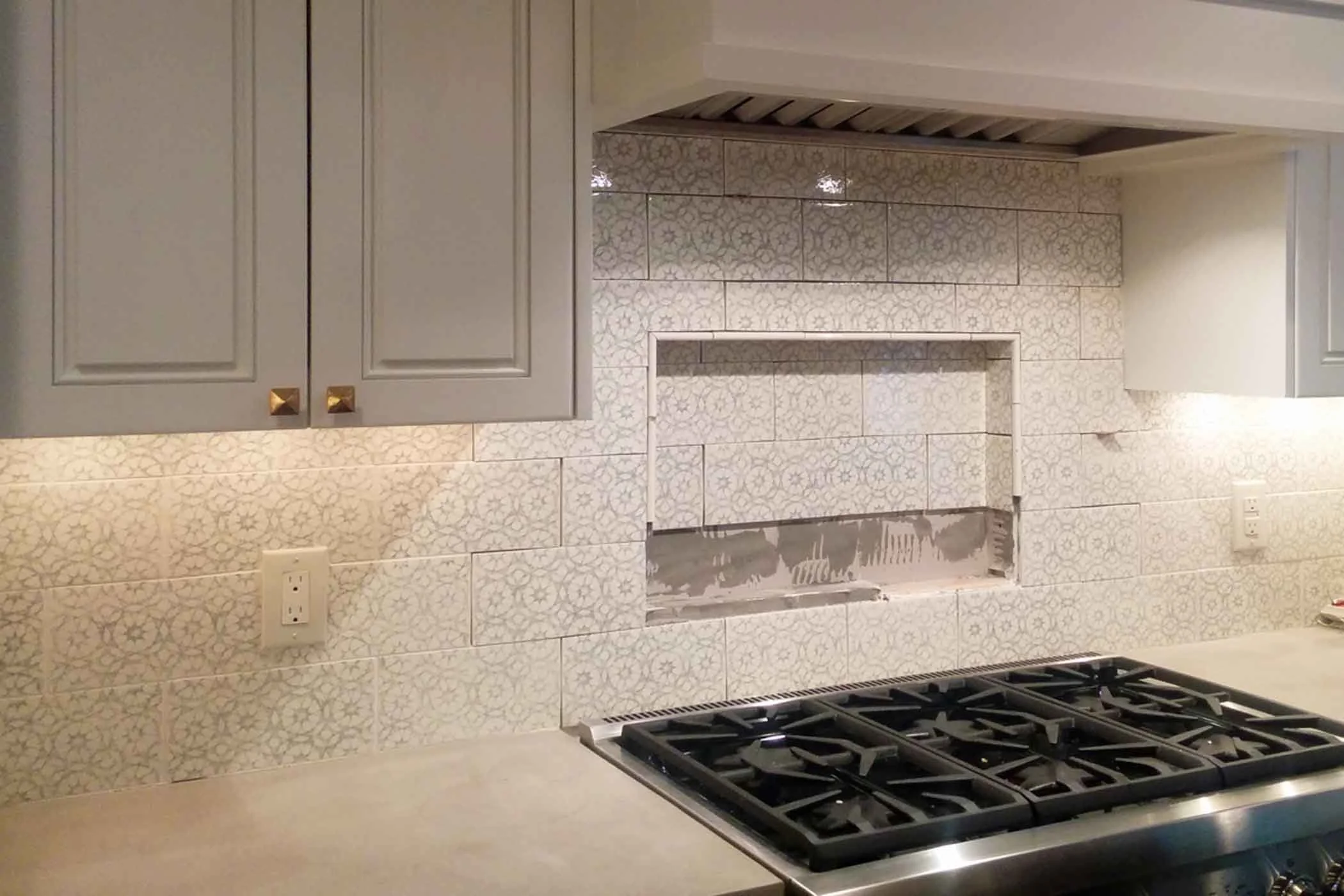
Accent tile from Etsy artisan or Ann Sacks: $15-$35 per square foot for handmade ceramic. Use this for 20%, maybe a decorative band, maybe behind the range, maybe framing a window.
Total cost for a 30 square-foot backsplash: $400-$600 instead of $2,400. Looks custom, not generic, because you mixed sources.
Where Subway Tile Works (And Where It Doesn't)
White subway tile isn't wrong. It's classic, it's clean, it works. The problem is only white subway tile with only standard grout and only typical layout.
Ways to make subway tile not boring:
Handmade subway tile from an Etsy ceramicist (slightly irregular edges, richer glaze)
Unexpected grout color (dark gray, charcoal, even blue)
Different layout (vertical stack, herringbone, mixed pattern instead of standard brick)
Mixed with something unexpected (wood shelves, brass rails, vintage mirrors)
Or skip subway tile entirely and use something with actual texture. Zellige tile from Morocco. Handmade ceramic with glaze variation. Vintage-look encaustic. The options exist at every price point once you look beyond the obvious. One inexpensive, comparably, unexpected backsplash is mirror, especially antiqued mirror. It’s stunning and different.
How to Think About Budget Allocation
Where custom/unique often costs LESS:
Vintage furniture vs. new designer furniture (reupholstery or refinishing will push the budget but is often worth it for the quality for your money).
Local craftspeople vs. big brand names
Small-batch tile vs. imported designer tile (sometimes)
Where you'll pay more but get better value:
Custom furniture in exact dimensions vs. settling for almost-right
Solid hardwood cabinetry vs. particleboard with veneer
Natural stone vs. nearly any other option
Where to save without sacrificing quality:
Commercial field tile + artisan accent tile
New lighting for general illumination + vintage for statement fixtures
Custom upholstery for key pieces (sofa, dining chairs) + retail for secondary furniture
The strategy: splurge on elements that define the space, save on the supporting cast.
My Process for Kitchen Selections
Let me show you how this works in practice:
Foundation (the expensive stuff that goes in first):
Cabinetry: Semi-custom from quality manufacturer OR fully custom local fabrication depending on budget and timeline. Custom inserts for divided storage, trash, and pull-outs.
Countertops: Visit stone yards to select actual slabs OR specify engineered quartz
Tile: Commercial for field (Daltile or Marazzi or Tile Shop or Zia) PLUS handmade accent from Etsy maker or ZIA Tile or Waterworks.
Fixtures:
Appliances: Based on function, purchased through local dealers. I like Mountain High Appliance.
Faucet: Splurge here (everyone sees it daily). Maybe Waterworks outlet find. Buy from a plumbing store such as Ultra Design Center for higher quality fixtures (inside even if the outside looks the same).
Shower plumbing: More utilitarian if needed, but same finish as faucet. Make sure you include a handshower!
Lighting (where personality happens):
Vintage pendants over island (Chairish, local antique stores)
New sconces flanking range (Rejuvenation)
Custom flushmount fixtures for breakfast nook (Etsy maker)
Hardware:
Unlacquered brass from Rejuvenation (develops beautiful patina)
OR vintage glass knobs from Etsy
OR modern pulls from commercial supplier
OR custom leather from Etsy leather worker
Final layers:
Window treatments: Custom from local workroom using trade fabric. Simple window treatments frame the view, they’re necessary.
Textiles: Mix of sources (Loloi for outdoor hardwearing rugs, Ebay for antique rugs, Etsy for custom pillows)
Decorative objects: Local galleries and antique shops
This layered approach: commercial foundation + custom accents + vintage character—is how you create spaces that feel collected, not catalog-ordered.
Why This Matters Specifically in the Suburbs
Throughout Centennial, Castle Pines, Highlands Ranch, and Littleton, I see newly renovated homes that look professional but feel generic. Same materials from same five sources. But I know the homeowners have more style than their house is showing.
When you source thoughtfully; custom fabricators, vintage dealers, small-batch artisans, unexpected online finds, the space has layers. It feels collected. It tells a story about you, not just about current trends.
This is especially valuable here where neighborhoods often have similar home styles. Your 1980s Centennial ranch benefits from materials that distinguish it from neighbors. Your Castle Pines new construction needs personality layered onto builder-grade selections. Your Littleton mid-century modern deserves materials that honor its heritage while serving modern life.
Start Where You Are
You don't need to source everything uniquely. You need to source something uniquely.
Maybe it's one handmade tile element in an otherwise commercial backsplash. Maybe it's vintage lighting fixtures with actual patina. Maybe it's custom cabinet pulls that nobody else has. Maybe it's an antique towel bar that cost $40 on Etsy but makes your bathroom feel special.
Start by walking through Denver showrooms and big box stores. Note what's widely available. Then ask: what would make my space feel different?
That unique element becomes your starting point. Build around it with accessible materials, and your home will feel curated.
The best homes, whether in Berlin or Centennial, mix the accessible with the unexpected. Commercial tile with handmade accents. New furniture with vintage lighting. Standard appliances with custom millwork.
That's how you create a home where every element feels intentionally chosen. Because it was.
Work With Me
Whether you're renovating in Centennial or Highlands Ranch, building new in Castle Pines, or restoring a historic home in Littleton—I help you source materials that make your space uniquely yours.
Design Consultation: 2 hours covering material options, sourcing recommendations, realistic budget guidance.
Partial Design Services: Professional material selections and sourcing for specific phases while you manage execution.
Full-Service Design: Complete material sourcing, procurement, and project management including access to all trade-only resources.
Schedule a consultation to discuss your project.
Related Articles:
About Jamie House Design
With 20+ years designing homes internationally and throughout Colorado, Jamie House has developed an extensive network of artisans, fabricators, and specialty sources for creating truly unique residential interiors. Based in Centennial, she works exclusively within South Denver suburbs, bringing global resources to local projects.
Service areas: Centennial, Castle Pines, Highlands Ranch, Littleton, Cherry Hills Village, Greenwood Village, Lone Tree